
Canada’s entrepreneurial landscape in 2026 presents a fertile ground for ventures that require minimal upfront capital yet promise substantial returns. The convergence of advanced digital infrastructure, evolving consumer behaviors, and supportive government programs has created a unique window for aspiring business owners. From tech-enabled home services to specialized e-commerce, the most lucrative paths leverage skills and technology rather than heavy physical assets. This guide dissects the most viable, low-investment business opportunities across the country, providing a clear roadmap to profitability.
Key Takeaways
- The digital services sector, including AI consulting and cybersecurity, offers margins exceeding 60% with startup costs under $5,000.
- Canada’s aging population drives consistent demand in health and wellness coaching, a field with low regulatory barriers and high personalization potential.
- E-commerce reselling through platforms like Shopify and Facebook Marketplace remains a top performer, with the dropshipping model eliminating inventory risk.
- Government grants and tax incentives, such as the Canada Digital Adoption Program, significantly reduce the financial burden for tech-focused startups.
- Franchising in recession-resistant industries like home maintenance provides a structured path with proven systems, though initial fees vary widely.
- Remote business models are not just a trend but a structural shift, allowing entrepreneurs in smaller cities to access national and global markets.
Why Canada’s 2026 Economy Favors Small-Scale Entrepreneurs
Canada’s GDP growth, projected by the Bank of Canada to stabilize around 2.1% in 2026, is increasingly driven by small and medium-sized enterprises (SMEs). These businesses account for nearly 90% of private-sector employment. The shift toward a gig economy and remote work has dismantled traditional geographic barriers. An entrepreneur in Halifax can now seamlessly serve clients in Vancouver, a dynamic that flattens the competitive landscape. Furthermore, the federal government’s renewed focus on innovation through programs like the Scientific Research and Experimental Development (SR&ED) tax credit provides non-dilutive funding that is particularly advantageous for bootstrapped startups.
Consumer preferences have also matured. There is a marked preference for personalized, local, and sustainable services over mass-produced goods. This creates niches where agility and customer intimacy—strengths of small operators—outweigh the scale advantages of large corporations. The key is identifying sectors where digital tools can amplify a personal touch, creating a defensible moat against larger competitors.

Digital Services: The High-Margin Frontier
The digital services sector remains the most accessible high-return domain. Startup costs are primarily tied to existing skills, a reliable computer, and a high-speed internet connection. The critical factor is specialization. Generalist virtual assistants face intense global competition and price compression. In contrast, specialists command premium rates and build recurring revenue streams.
AI Integration Consulting for Small Businesses
According to a 2026 report from the Business Development Bank of Canada (BDC), 67% of Canadian SMEs plan to adopt artificial intelligence tools within the next year but lack the internal expertise to do so effectively. This gap represents a massive opportunity. An AI integration consultant does not need to be a data scientist. The role involves auditing a client’s workflows—such as customer service, inventory management, or marketing—and implementing off-the-shelf AI solutions like advanced chatbots, predictive text generators, and automated scheduling systems.
Startup costs are negligible: a professional website, a portfolio of case studies (which can be built through pro-bono initial projects), and subscriptions to the AI tools themselves. Monthly retainers for this service typically range from $1,500 to $4,000 per client. As Priya Lakhani, a Toronto-based digital transformation strategist, notes: “Small business owners are overwhelmed by AI hype. They don’t need another tool; they need a translator who can bridge the gap between a complex algorithm and a practical, profit-boosting application. That translator is the 2026 entrepreneur’s most valuable role.”
Cybersecurity Awareness Training
With the Canadian Centre for Cyber Security reporting a 34% increase in ransomware attacks targeting small businesses in 2025, cybersecurity is no longer optional. However, most breaches originate from human error, not system failures. A business providing live, interactive cybersecurity awareness training for employees addresses this vulnerability directly. This venture requires certifications like the Certified Information Systems Security Professional (CISSP) or Certified Ethical Hacker (CEH) to establish credibility, but the core service—teaching phishing identification, password hygiene, and data handling protocols—is low-tech and high-impact. Packages can be sold as one-time workshops or annual subscription services with quarterly update sessions.
Health and Wellness: Capitalizing on Demographic Shifts
Canada’s demographic trajectory is a powerful economic signal. Statistics Canada data confirms that over 7.3 million Canadians are now aged 65 and older, a figure that is climbing steadily. This cohort is not only growing but also increasingly proactive about maintaining vitality and independence. This creates a sustained demand for non-clinical health and wellness services that can be started with minimal investment.
Specialized In-Home Personal Training
While the general personal training market is saturated, specialization unlocks profitability. Focusing on functional fitness for seniors—exercises that improve balance, bone density, and the ability to perform daily tasks—is a recession-resistant niche. The business model is mobile: the trainer travels to clients’ homes or community centers, eliminating the overhead of a gym lease. Certification from a recognized body like CanFitPro is essential. The key differentiator is a holistic intake process that includes a health history review and coordination with the client’s healthcare providers, positioning the service as a therapeutic necessity rather than a luxury.
Corporate Wellness Program Coordination
On the other end of the demographic spectrum, corporations are grappling with record levels of employee burnout. A 2026 survey by Deloitte Canada indicates that 58% of Canadian companies plan to increase their investment in employee well-being programs. A corporate wellness coordinator acts as a curator and facilitator, bringing in vetted practitioners for on-site or virtual sessions covering meditation, ergonomic assessments, nutrition workshops, and stress management. The coordinator’s value lies in program design and vendor management, not in personally delivering every service. This is a high-trust, relationship-based business with low startup costs, primarily requiring a strong network and a polished proposal template.
E-commerce Reselling: The Evolution of Retail Arbitrage
E-commerce in Canada is projected to surpass $100 billion in sales by 2026, according to eMarketer. The opportunity has shifted from simply being present online to mastering niche curation and supply chain agility. The traditional model of buying wholesale and holding inventory is capital-intensive and risky. The modern, low-investment approach relies on two refined strategies: high-end thrifting and print-on-demand (POD).
Curated Vintage and Thrift Flipping
This is not casual garage sale reselling. It is a systematic business of sourcing high-quality, often luxury, second-hand goods from thrift stores, estate sales, and online auctions, then reselling them on platforms like Poshmark, Depop, and eBay. Success requires deep knowledge in a specific vertical—such as vintage denim, mid-century modern decor, or collectible sneakers. The investment is purely in inventory, which can start with as little as $200. The return on investment (ROI) for a skilled picker can exceed 300%. The business model is highly scalable, as profits can be reinvested into increasingly valuable inventory.
Print-on-Demand Niche Apparel
Print-on-demand eliminates inventory risk entirely. An entrepreneur creates designs for a hyper-specific audience—for example, “Canadian Critical Care Nurses” or “Newfoundland Dog Owners”—and uploads them to a platform like Printful, which integrates with a Shopify store. When a customer orders a t-shirt or mug, the item is printed and shipped by the third-party supplier. The entrepreneur’s sole focus is design and marketing. The margin per item is lower than bulk manufacturing, but the zero upfront cost and zero inventory risk make it an ideal testing ground for brand concepts. The key is to use data from social media groups and Google Trends to validate demand before creating a single design.
Home Services: The Recession-Resistant Mainstay
Home services are a cornerstone of the Canadian economy because they are non-discretionary. A leaking pipe or a snow-covered driveway cannot be ignored. The opportunity in 2026 lies in professionalizing these services with a tech-enabled customer experience that contrasts sharply with the industry’s traditionally fragmented, pen-and-paper operators.
Eco-Friendly Residential Cleaning
The cleaning industry has low barriers to entry, but a premium, eco-friendly brand can command significantly higher prices. This business uses only biodegradable, non-toxic cleaning agents and microfiber technology, appealing to the 73% of Canadian consumers who, according to a NielsenIQ report, are willing to pay more for sustainable products. The initial investment covers a supply of professional-grade eco-friendly products, a portable high-efficiency particulate air (HEPA) vacuum, and a simple booking website. The key to high returns is a subscription model, where clients sign up for weekly or bi-weekly service, ensuring predictable, recurring revenue.
Smart Home Installation and Troubleshooting
As Canadian homes become increasingly connected, a significant service gap has emerged. Many consumers purchase smart thermostats, video doorbells, and mesh Wi-Fi systems but struggle with installation, integration, and troubleshooting. A mobile smart home technician service fills this gap. The required tools are basic, and the technical knowledge can be acquired through manufacturer-specific certifications, many of which are free. This business leverages the fact that the perceived complexity of technology is high, allowing a knowledgeable technician to charge a premium for a service that is often quick to deliver.
Comparative Analysis of Top Low-Investment Ventures
The following table provides a direct comparison of the business models discussed, allowing for a clear, data-driven assessment of their potential.
| Business Model | Est. Startup Cost (CAD) | Potential Annual Revenue (CAD) | Key Success Factor | Risk Level |
|---|---|---|---|---|
| AI Integration Consulting | $1,000 – $3,000 | $80,000 – $150,000 | Deep specialization in 1-2 AI tools | Low |
| Cybersecurity Training | $2,000 – $5,000 | $70,000 – $120,000 | Recognized certifications (CISSP, CEH) | Low |
| Senior Personal Training | $1,500 – $4,000 | $60,000 – $100,000 | CanFitPro certification & liability insurance | Medium |
| Corporate Wellness Coordination | $500 – $2,000 | $75,000 – $130,000 | Strong B2B network and proposal skills | Medium |
| Curated Vintage Reselling | $200 – $1,000 | $40,000 – $90,000 | Expert product knowledge in a niche | Medium-High |
| Print-on-Demand Apparel | $0 – $500 | $30,000 – $80,000 | Data-driven niche selection and ad creative | Low |
| Eco-Friendly Home Cleaning | $1,000 – $2,500 | $50,000 – $90,000 | Subscription model and 5-star reviews | Low |
| Smart Home Installation | $1,500 – $3,000 | $65,000 – $110,000 | Manufacturer certifications and insurance | Low |
Navigating the Regulatory and Financial Landscape
Launching a business in Canada requires navigating a structured but supportive regulatory environment. The first step is choosing a business structure. A sole proprietorship is the simplest and cheapest to register, but it does not separate personal and business liabilities. For most of the ventures discussed, incorporating at the federal or provincial level is a prudent move that can be completed online for a few hundred dollars. This step protects personal assets and unlocks access to the small business tax rate, which is significantly lower than personal income tax rates.
Financing a low-investment business often does not require a traditional bank loan. The Canada Small Business Financing Program (CSBFP) can be a resource, but for micro-ventures, personal savings, a small line of credit, or a business credit card with a 0% introductory APR are more practical. Crucially, entrepreneurs should immediately establish a separate business bank account to maintain clear financial records, a practice that simplifies tax filing and is essential for credibility. For those exploring work-from-home models, understanding the home office expense deductions can significantly reduce the tax burden in the first year.
Actionable Steps to Launch Your Venture in 30 Days
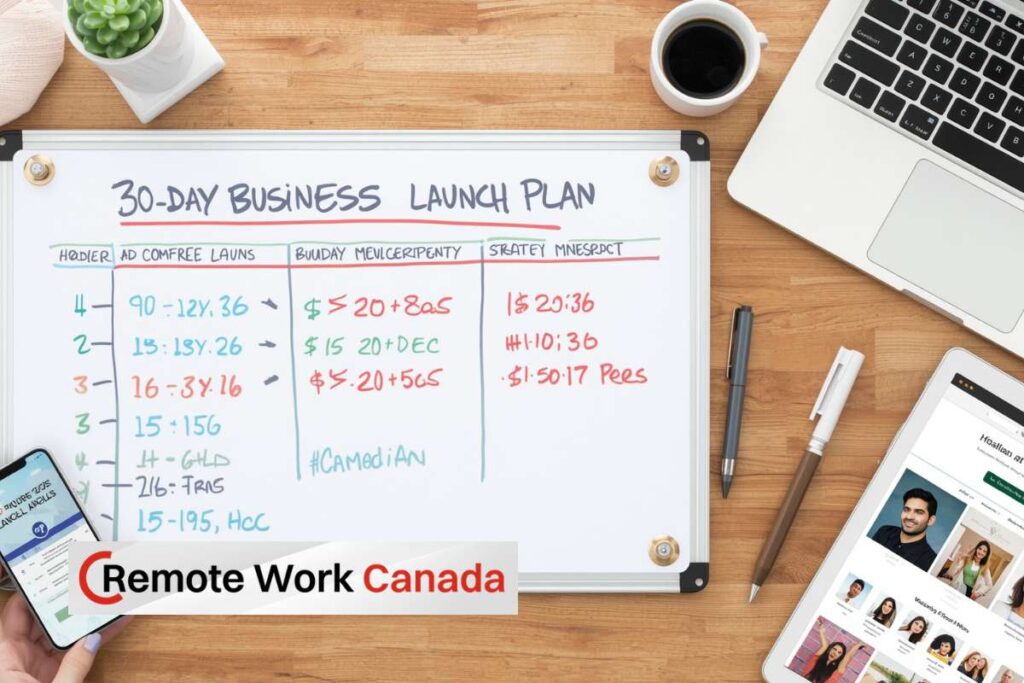
Moving from concept to first client requires a disciplined, time-bound plan. This 30-day launch sequence is designed for service-based and online businesses with minimal setup requirements.
- Days 1-5: Legal Foundation and Validation. Register your business name and structure. Simultaneously, conduct five “validation calls” with potential customers in your target market. Do not sell; simply ask about their pain points to confirm your service solves a real, urgent problem.
- Days 6-10: Brand and Digital Presence. Build a simple, one-page website with a clear value proposition, your bio, and a contact form. Set up a professional email address. Create profiles on the two social media platforms where your ideal clients spend their time.
- Days 11-15: Productization and Pricing. Define your service as a clear, fixed-price package, not an ambiguous hourly rate. For example, “8-Week Senior Mobility Jumpstart Program” is more compelling than “Personal Training, $70/hour.” Set your price based on the value of the outcome, not your time.
- Days 16-20: Prospecting and Outreach. Identify 50 ideal prospects. Send personalized, non-templated emails or direct messages that reference a specific detail about their business or life. Offer a free 15-minute consultation or a valuable piece of information, not a sales pitch.
- Days 21-25: The Pilot Offer. Launch a “beta” version of your service at a reduced rate for your first three clients. The goal is to secure testimonials, refine your process, and build a case study. Treat these clients as partners in your development.
- Days 26-30: Systematization and Iteration. Based on the pilot feedback, create standard operating procedures (SOPs) for every aspect of your service delivery. Set up a simple client relationship management (CRM) tool to track leads and communications. Adjust your offering and pricing based on real-world data.
Common Pitfalls and How to Avoid Them
The path of entrepreneurship is littered with avoidable mistakes. A primary error is the “Field of Dreams” fallacy—the belief that building a product or service will automatically attract customers. In reality, marketing is not a one-time event but a continuous process. A business should allocate at least 50% of its initial effort to outreach and sales, not just product perfection.
Another critical mistake is underpricing. New entrepreneurs often charge too little, hoping to compete on price. This is a trap. Low prices attract the most demanding, least loyal customers and make it impossible to sustain the business. As Michael LeBlanc, a retail and startup advisor based in Halifax, states: “Price is a signal of value. If you charge a premium and deliver an exceptional experience, you will attract clients who value your expertise and respect your boundaries. Competing on price is a race to the bottom that a small business can never win.”
Finally, neglecting legal and tax obligations from day one can be fatal. A common scenario is a profitable e-commerce reseller who fails to register for and remit GST/HST. Once sales exceed the $30,000 threshold, this becomes a legal requirement. The Canada Revenue Agency (CRA) can audit retroactively, leaving the business owner with a crippling, unexpected tax bill. Consulting with a small business accountant for a one-hour setup session is a high-return investment.
Leveraging Canada’s Unique Geographic and Cultural Advantages
A business opportunity in Canada is not a monolith; it is a tapestry of regional strengths. An entrepreneur should strategically align their venture with their province’s economic drivers. For example, a tech-focused business benefits from the dense ecosystem of the Toronto-Waterloo corridor, where talent and venture capital are concentrated. A wellness or tourism-adjacent business thrives in British Columbia, leveraging the province’s global brand for health and natural beauty.
Furthermore, Canada’s bilingual and multicultural fabric is a competitive advantage. A business that can serve clients in both English and French instantly doubles its addressable domestic market. Similarly, cultural competency allows an entrepreneur to tailor products and services to Canada’s diverse diaspora communities, creating micro-niches that are invisible to larger, less agile competitors. This is particularly potent in e-commerce and food-based businesses.
Frequently Asked Questions
What is the absolute cheapest business to start in Canada right now?
A print-on-demand e-commerce store or a digital consulting service (like AI integration) can be started for under $500. These models require no inventory, no physical premises, and the primary investment is your time and existing expertise. The key is to validate the market demand through free social media channels before spending any money on a website or ads.
Do I need to register a business to start a side hustle in Canada?
You can operate a small side hustle as a sole proprietor under your own legal name without registering a business name. However, if you want to operate under a different name, you must register it with your province. Even as a sole proprietor, you are legally obligated to report all income on your personal tax return and may need to register for GST/HST if your revenue exceeds $30,000 over four consecutive quarters.
Which Canadian cities are best for starting a low-investment business in 2026?
For digital and remote-first businesses, location is less critical, but proximity to networks helps. Toronto and Vancouver offer the largest client bases and networking events. However, cities like Calgary, Edmonton, and Halifax are increasingly attractive due to lower living costs, growing tech scenes, and strong local government incentives for small business development.
How can I get a government grant to start my business?
Direct grants for starting a business are rare; most government support comes as loans or tax credits. The Canada Digital Adoption Program (CDAP) offers grants for digital transformation, and the SR&ED tax credit can recover a portion of R&D costs. The best starting point is the Business Benefits Finder tool on the Innovation Canada website, which matches your profile with available programs.
Is a franchise a good low-investment business opportunity?
Some service-based franchises, particularly in home maintenance and cleaning, can be entered for an initial investment of $20,000 to $50,000. While higher than a pure startup, a franchise provides a proven operating system, brand recognition, and training, which significantly reduces the risk of failure. It is a viable middle path for those who want a structured business model.
What are the biggest risks for a home-based business in Canada?
The biggest risks are professional isolation, which can slow learning, and a lack of separation between work and personal life, leading to burnout. Legally, the main risk is inadequate insurance. A standard home insurance policy does not cover business-related liabilities or client injuries. A separate business liability insurance policy is a non-negotiable expense, even for a small consulting practice.
How do I find my first clients for a service-based business?
The most effective, zero-cost method is a “give before you get” strategy. Identify your ideal clients on LinkedIn or in local Facebook groups. Offer them a free, high-value resource—such as a security audit checklist, a mobility assessment guide, or a sustainability report for their home. This establishes your expertise and creates a warm, receptive audience for a follow-up conversation about your paid services.
Conclusion
The landscape for a business opportunity in Canada in 2026 is defined not by a single gold rush but by a multitude of profitable, low-investment niches. The common thread among the most promising ventures is the strategic application of digital tools to deliver personalized, specialized services. Success is not a function of large capital but of deep focus, professional credibility, and a systematic approach to client acquisition. The barriers to entry have never been lower for those who can identify a specific problem and solve it with expertise and empathy. The most critical step is the first one: moving from analysis to action. For more resources on building a flexible, location-independent career that complements these business models, explore our comprehensive resource library. To take the next step in your entrepreneurial journey, submit your professional profile and let our team help you connect with the right opportunities.
References
- Bank of Canada – Economic projections and monetary policy reports.
- Business Development Bank of Canada (BDC) – 2026 SME AI adoption survey.
- Canadian Centre for Cyber Security – 2025 ransomware threat report for small businesses.
- Statistics Canada – Demographic data on population aging and SME employment statistics.
- Deloitte Canada – 2026 corporate wellness and employee well-being investment survey.
- eMarketer – Canadian e-commerce sales forecast for 2026.
- NielsenIQ – Report on Canadian consumer willingness to pay for sustainable products.
- Canada Revenue Agency – Guidelines on GST/HST registration and home office expense deductions.