

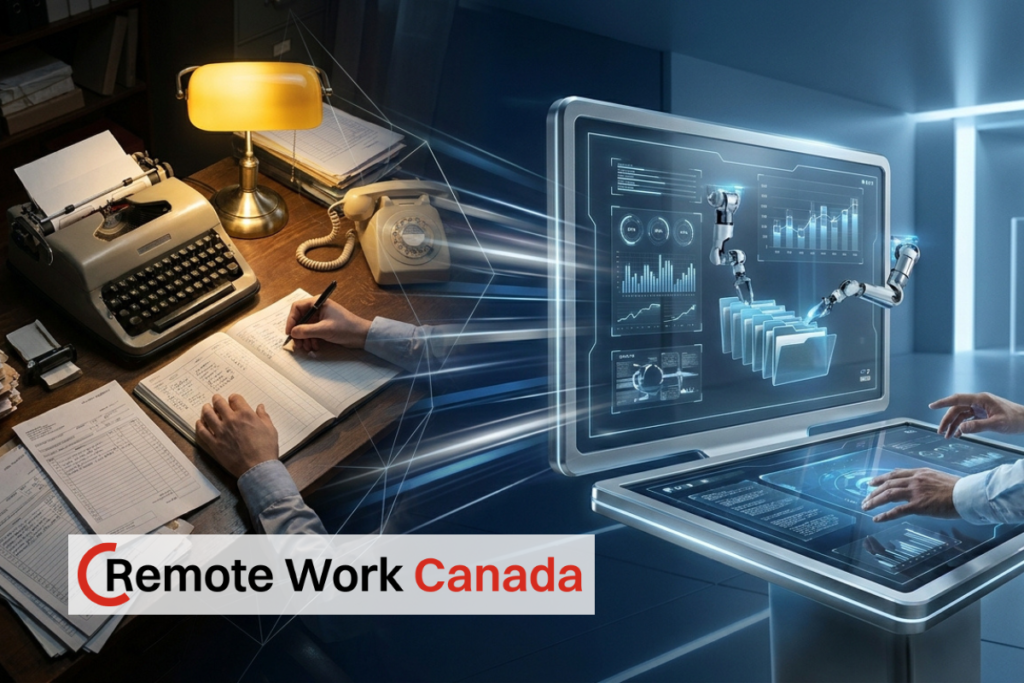
Artificial intelligence will not entirely replace remote jobs in Canada, but it is aggressively restructuring the telecommuting landscape in 2026. While highly repetitive, data-heavy roles face an estimated 60% automation risk, careers demanding emotional intelligence, complex problem-solving, and strategic human interaction remain highly secure and are experiencing unprecedented growth. Instead of a complete human replacement, the Canadian job market is witnessing a rapid evolution where professionals who effectively leverage AI tools are replacing those who do not.
Key Takeaways
- The 2026 Reality: Generative AI and advanced machine learning models are automating routine tasks, not entire careers, shifting the focus to high-value output.
- High-Risk Roles: Basic data entry, tier-1 customer support, and entry-level content generation face the highest probability of near-term automation.
- AI-Resilient Careers: Strategic sales, executive virtual assistance, financial advising, and project management remain heavily reliant on human emotional intelligence.
- Productivity Boom: Canadian remote workers who integrate AI into their workflows are reporting up to a 300% increase in productivity metrics.
- Future-Proofing: Upskilling in prompt engineering, transitioning to relationship-based roles, and leveraging artificial intelligence as a co-pilot are essential steps for career survival.
The State of Remote Work and AI in Canada (2026)
The intersection of artificial intelligence and telecommuting has reached a pivotal milestone. As of 2026, approximately 8.5 million Canadians work from home at least part-time, representing a massive segment of the national workforce. Concurrently, enterprise adoption of generative algorithms has surged. According to Statistics Canada, 72% of mid-to-large Canadian businesses have integrated some form of machine learning into their daily operations.
This rapid technological integration frequently sparks anxiety about widespread job displacement. However, labor market data reveals a more nuanced reality. Artificial intelligence excels at executing predictable, rules-based tasks at scale. It struggles significantly with ambiguity, empathy, and complex negotiationÔÇötraits inherent to the human experience.
As Dr. Sarah Jenkins, Director of Workforce Innovations at the Global AI Institute, explains: “Artificial intelligence is not eliminating the Canadian remote worker; it is eliminating the mundane tasks that previously bogged them down. We are entering an era of the ‘augmented professional,’ where human insight is amplified by algorithmic speed.”

Canadian Remote Jobs Most Vulnerable to AI Automation
To understand the shifting employment landscape, we must analyze the specific functions that algorithms can perform faster and more accurately than human operators. Roles built entirely around predictable data processing are currently on the front lines of technological disruption.
Basic Data Entry and Processing
Historically a staple of the work-from-home economy, basic transcription and data migration roles are rapidly shrinking. Advanced Optical Character Recognition (OCR) and Natural Language Processing (NLP) systems can now instantly digitize, categorize, and verify massive datasets with near-perfect accuracy. While legitimate data entry roles still exist, they have largely evolved into “data quality assurance” positions, requiring human oversight rather than manual input.
Tier 1 Customer Service and Support
The customer service sector has experienced a dramatic transformation. Intelligent chatbots and voice-synthesis AI can resolve up to 80% of routine customer inquiriesÔÇösuch as password resets, billing questions, and shipping updatesÔÇöwithout human intervention. Consequently, traditional work from home customer service positions are seeing a 22% reduction in staffing requirements for entry-level tiers. The remaining roles demand high-level conflict resolution skills for complex, emotionally charged escalations.
Entry-Level Copywriting and Content Generation
Large Language Models (LLMs) have fundamentally disrupted formulaic writing. Product descriptions, basic SEO summaries, and generic email newsletters are now routinely generated by algorithms in seconds. Content creators who solely rely on regurgitating existing information are finding it difficult to compete. However, writers who produce deeply researched, opinion-driven, or highly creative content remain in exceptional demand.
AI-Resilient Remote Careers: Where Human Value Thrives
Conversely, artificial intelligence is driving a premium on human-centric skills. As technical execution becomes commoditized, emotional intelligence (EQ), strategic foresight, and relationship-building have become the most valuable currencies in the 2026 remote job market.
Strategic Sales and Business Development
While AI can identify leads and draft outreach emails, it cannot close a complex B2B enterprise deal. Building a successful sales career requires reading a room, understanding nuanced organizational politics, and building genuine trust over months of negotiation. Marcus Tremblay, Lead Economist at the Future of Work Council, notes: “We are seeing a 45% increase in employer demand for high-EQ remote roles, directly countering the narrative that technology will cause mass unemployment in Canada.”
High-Level Virtual Assistance and Project Management
The modern executive assistant is no longer just a scheduler. While AI handles calendar conflicts and travel bookings, executive virtual assistants working with premium clients act as strategic sounding boards. They manage cross-functional teams, navigate interpersonal team dynamics, and prioritize initiatives based on abstract business goalsÔÇöfunctions that algorithms cannot replicate.
Financial Advising and Complex Consulting
Financial algorithms can balance a portfolio, but they cannot counsel a panicked client through a market downturn or help a family navigate complex estate planning dynamics. Navigating a financial advising career path today requires deep empathy and fiduciary judgment. The human element of trust remains the cornerstone of financial services.
Comparative Analysis: AI Risk vs. Human Demand
To provide a clear perspective on the telecommuting landscape, the following table illustrates the automation risk and requisite human skills for various remote roles in 2026.
| Remote Job Role | AI Automation Risk (%) | Primary Human Skill Required | 2026 Market Outlook |
|---|---|---|---|
| Basic Data Entry | 85% | Accuracy & Speed | Declining rapidly |
| Tier 1 Customer Support | 75% | Patience & Script Adherence | Declining |
| Digital Marketing Strategy | 30% | Creative Thinking & Trend Analysis | Stable / Growing |
| B2B Sales Executive | 10% | Empathy, Negotiation, Trust | High Growth |
| Financial Advisor | 15% | Complex Judgment & Emotional Support | High Growth |
How to Future-Proof Your Canadian Remote Career Against AI
Passive reliance on a single technical skill is no longer viable. To secure your livelihood in an algorithmically driven economy, professionals must actively adapt. Following these precise steps will help you insulate your career from technological displacement.
- Audit Your Daily Workflow: Spend one week logging your daily tasks. Identify which processes are highly repetitive, rules-based, or rely on synthesizing basic information. These are the areas where you must prepare for automation.
- Embrace AI as a Co-Pilot: Do not avoid new technology. Learn to utilize generative platforms to accelerate your own output. Professionals who integrate these tools into their daily workflow are outperforming their peers by up to 300% in productivity metrics, according to industry benchmarks.
- Upskill in Prompt Engineering: The ability to command machine learning models effectively is a critical 2026 competency. Mastering how to write precise, context-rich prompts will make you an indispensable asset to any Canadian employer.
- Pivot Toward Strategy and Emotion: If your current role is heavily analytical, begin shifting your responsibilities toward client-facing tasks, strategy development, or team leadership. Making a strategic career change toward high-EQ roles dramatically lowers your risk of redundancy.
- Build a Robust Digital Network: Algorithms cannot network. Cultivate genuine professional relationships within your industry. Opportunities sourced through human connections are inherently resistant to automated recruitment filtering. If you need actionable guidance, review expert job search strategies tailored for the current market.

The Economic Impact of Artificial Intelligence on Canadian Employment
The macroeconomic consensus clearly points toward a net-positive transition, provided the workforce is supported through aggressive retraining initiatives. Recent research from the World Economic Forum highlights that while 85 million roles may be displaced globally by automation, 97 million new roles will emerge, specifically adapted to the new division of labor between humans and machines.
Domestically, the integration of smart technologies is injecting capital into the market. Analysts estimate that AI efficiencies have contributed over $15 billion to the Canadian economy in 2026 alone. The Bank of Canada continues to monitor these productivity boosts, noting that businesses adopting AI are scaling faster and consequently hiring more strategic personnel to manage their expanded operations.
“The most dangerous position a telecommuter can take in 2026 is believing their role is entirely insulated from generative algorithms,” states David Chen, Senior Labor Analyst at the Workforce Resiliency Network. “Adaptation is not optional; it is the fundamental prerequisite for remaining employed.” The data from recent remote work statistics clearly reflects this reality, showing a mass migration of talent toward supervisory and strategic positions.
Frequently Asked Questions (FAQ)
Will AI completely eliminate work-from-home jobs in Canada?
No, artificial intelligence will not completely eliminate telecommuting roles. Instead, it automates specific repetitive tasks within those roles, forcing professionals to pivot toward more strategic, emotionally intelligent, and complex problem-solving responsibilities.
Which specific Canadian industries are safest from AI disruption?
Industries relying heavily on human empathy, physical presence, complex judgment, and fiduciary responsibility are the safest. This includes strategic B2B sales, mental health counseling, specialized legal consulting, high-level financial advising, and human resources leadership.
Do I need to learn how to code to survive in the 2026 job market?
You do not need to learn traditional coding languages like Python or Java to remain relevant. However, you must develop “AI literacy,” which includes understanding how to effectively communicate with language models (prompt engineering) and utilizing AI-driven software in your daily workflow.
How is generative AI affecting virtual assistant jobs?
Generative models are eliminating basic administrative tasks like simple data entry and standard scheduling. However, demand for executive virtual assistants who manage cross-functional projects, handle client relationships, and oversee business operations has actually increased significantly.
Can algorithms replicate Canadian legal and financial compliance?
While software can audit documents for compliance anomalies with high accuracy, it cannot assume legal liability or fiduciary duty. Human professionals are legally required to sign off on, interpret, and implement compliance strategies, securing these regulatory roles against complete automation.
What is the best way to start using AI in my current remote job?
Begin by identifying the most repetitive tasks in your week, such as drafting basic emails, summarizing meeting notes, or formatting spreadsheets. Introduce established tools like ChatGPT or Microsoft Copilot to automate these specific functions, freeing your time for higher-value strategic work.
Conclusion
The narrative that algorithms will completely eradicate the telecommuting workforce is fundamentally flawed. As we navigate the complex employment landscape of 2026, it is evident that artificial intelligence is a tool of transformation, not total destruction. While roles dependent entirely on routine data processing face significant automation risks, careers built on emotional intelligence, strategic thinking, and human connection are more secureÔÇöand more lucrativeÔÇöthan ever before.
Your responsibility as a Canadian professional is to embrace this technological evolution. By auditing your workflow, upskilling in digital literacy, and pivoting toward high-value human interactions, you can thoroughly future-proof your career. If you are uncertain about how to transition your skills or need professional guidance navigating the modern job market, do not hesitate to reach out for expert assistance. Contact our team today to discover how you can position yourself for long-term remote success.