
The landscape of customer service has permanently shifted, and as of 2026, remote call centre jobs in Canada represent one of the most accessible entry points into the work-from-home economy. Whether you are a student, a parent returning to the workforce, or someone seeking geographic flexibility, the demand for virtual agents is robust. Major telecommunications firms, financial institutions, and global business process outsourcers (BPOs) have solidified their distributed workforce models, meaning you no longer need to commute to a brick-and-mortar site to build a career in client support. This guide breaks down exactly where to find legitimate openings, what compensation and equipment to expect, and how to navigate the application process successfully.
Key Takeaways
- Major Canadian employers like TELUS, Rogers, and Concentrix consistently hire for home-based agent roles across multiple provinces.
- Bilingualism in English and French significantly increases earning potential, often commanding a premium of 15% to 20%.
- Most employers require a hardwired internet connection, a noise-cancelling headset, and a private workspace, but many provide the computer itself.
- Average hourly wages range from $18 to $26 CAD, with technical support roles often exceeding $30 per hour.
- Scams are prevalent; legitimate employers never ask for upfront payment for equipment or training.
- The interview process typically includes a virtual technical assessment and a simulated customer interaction.
The State of Virtual Customer Service in 2026
The pivot to distributed contact centres is no longer an experiment. According to Statistics Canada, the proportion of call centre agents working primarily from home has stabilized at roughly 65% of the total workforce in the sector, a massive jump from pre-pandemic levels. This shift is driven by advanced cloud-based telephony systems like Amazon Connect and Genesys Cloud, which allow supervisors to monitor queues and whisper-coach agents without being physically present. For the worker, this means the infrastructure is mature. You are not logging into a fragile VPN that crashes every hour; you are accessing enterprise-grade unified communications platforms.
Research from the International Customer Management Institute (ICMI) indicates that remote agents often demonstrate a 13% higher first-contact resolution rate compared to their in-office counterparts. The reduction in ambient noise and the comfort of a personalized workspace contribute to clearer communication. Consequently, employers are investing heavily in virtual onboarding. A report from Deloitte Canada highlights that 78% of Canadian contact centre leaders plan to maintain or increase their remote headcount through the end of 2026, prioritizing soft skills like empathy and digital literacy over proximity to a physical office.
Top Companies Hiring for Remote Call Centre Roles
Navigating the job boards can be overwhelming, but a core group of employers consistently posts openings for home-based agents. These organizations have refined their remote management practices and offer structured career paths. Below is a comparison of the major players in the Canadian market.
| Company | Typical Roles | Bilingual Premium | Equipment Provision |
|---|---|---|---|
| TELUS International | Customer Service, Tech Support, AI Data Annotation | Yes (approx. 18%) | Computer provided; headset required |
| Concentrix | Inbound Sales, Healthcare Support, Financial Services | Yes (approx. 15%) | Full equipment package shipped |
| Rogers Communications | Retention, Billing, Technical Support | Yes (approx. 20%) | Laptop provided; employee provides monitor |
| Arise Virtual Solutions | Independent Contractor roles (Retail, Travel) | Varies by client | Agent provides all equipment |
| 24-7 Intouch | Social Media Support, Chat, Voice | Yes (approx. 17%) | Computer and headset provided |
Beyond these giants, the financial sector is a heavy recruiter. Banks like TD and RBC frequently list remote advisory roles, though these often require prior financial services experience. For those seeking a more flexible arrangement, the remote work listings on our platform aggregate opportunities from these top-tier employers, filtering out the noise of unverified postings.
Compensation and Benefits: What You Can Realistically Earn
Compensation structures in Canadian virtual call centres have evolved beyond the minimum wage baseline. As of 2026, the average base wage for an English-only agent sits between $18 and $22 per hour. However, the data becomes more nuanced when you layer in skills and shift differentials. According to a 2026 salary survey by Randstad Canada, bilingual agents (English/French) command an average of $24 per hour, with top earners in technical support reaching $31 per hour.
Performance-based incentives are standard. Employers like Sitel Group and HGS Canada offer monthly bonuses ranging from $200 to $500 for metrics such as customer satisfaction scores (CSAT) and average handle time (AHT). Furthermore, full-time employees typically receive a benefits package that includes extended health care, dental, and a health spending account. A significant trend in 2026 is the “home office stipend.” Rogers, for example, provides a one-time $500 reimbursement for ergonomic chairs and desks, recognizing that a healthy workforce is a productive one.
It is critical to distinguish between employee and independent contractor models. Arise Virtual Solutions operates on a contractor model. While this offers extreme flexibility, you are responsible for your own taxes, Canada Pension Plan (CPP) contributions, and equipment. As Sarah Chen, a Senior Talent Acquisition Specialist at a national BPO, explains: “Candidates often see the higher headline rate for contractor roles and forget to deduct the overhead. When you factor in the cost of a computer, headset, and the loss of paid vacation, the employee model usually offers a better total compensation package for long-term stability.”

Technical Requirements and Home Office Setup
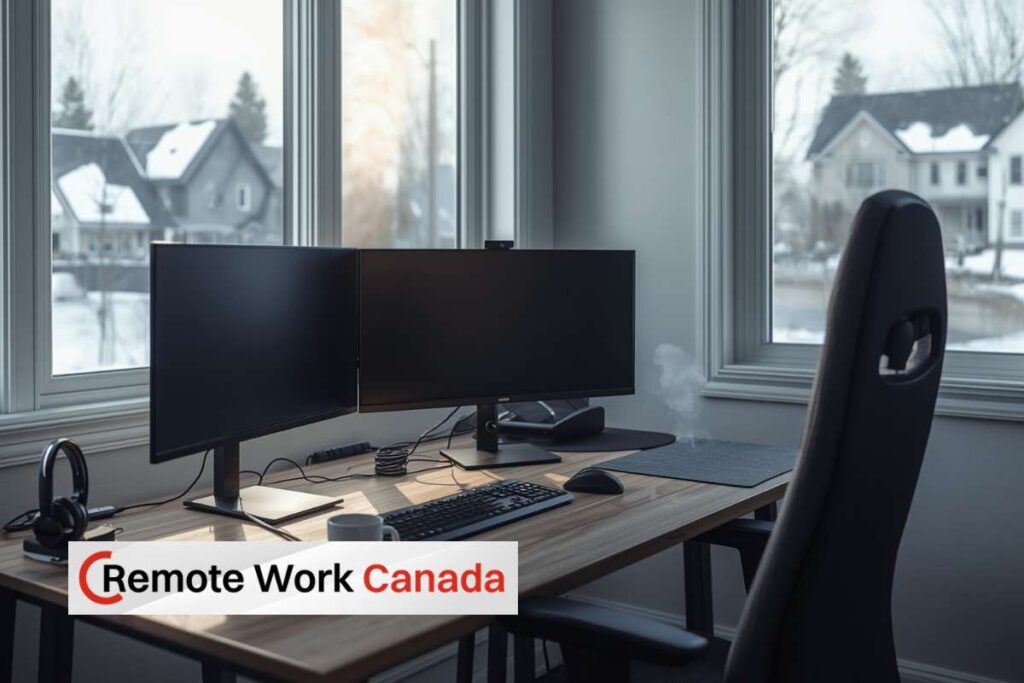
Your home office is your professional frontline. Employers have strict technical vetting processes to ensure you can handle the digital load. The non-negotiable requirements across almost all Canadian remote call centre jobs include a wired internet connection—Wi-Fi is universally rejected due to latency and packet loss issues. You will need a minimum download speed of 10 Mbps and an upload speed of 5 Mbps, though 25 Mbps down is preferred for video-enabled interactions.
The hardware checklist is specific:
- Computer: A Windows-based PC or laptop (Macs are often incompatible with legacy telephony software). Typically, an Intel i5 processor or equivalent, 8GB RAM minimum.
- Headset: A USB noise-cancelling headset is mandatory. The Leitner LH270 and Jabra Evolve 40 are industry standards.
- Monitor: Dual monitors are increasingly required for roles involving data entry alongside voice calls.
- Workspace: A dedicated, quiet room with a door that locks. Background noise, including pets and children, is grounds for termination in many contracts.
Before you apply, run a speed test and have the results ready. Many recruiters will ask for a screenshot. As Mark Tremblay, an IT Infrastructure Manager at a Montreal-based BPO, notes: “We reject about 20% of applicants at the technical check stage because they try to use a wireless connection or a Chromebook. The software simply won’t install. A hardwired connection and a Windows PC are the keys to the kingdom.”
How to Spot and Avoid Remote Job Scams
The popularity of work-from-home roles has attracted a wave of sophisticated scammers. In 2026, the Canadian Anti-Fraud Centre reports that employment scams are among the top five types of fraud by dollar loss. The most common scheme involves a fake interview via a messaging app like Telegram or WhatsApp, followed by a fraudulent cheque sent to “purchase equipment” from a specific vendor. The cheque bounces, and you are out the money you sent to the fake vendor.
Legitimate employers follow a strict protocol. They will never send you a cheque to buy equipment; they ship the equipment directly to your door. They will never ask for your Social Insurance Number (SIN) before a formal job offer letter is signed. They will never conduct an interview solely via text chat. Always verify the email domain. A recruiter from TELUS will use an @telus.com address, not a Gmail or Yahoo account. If you are unsure, navigate directly to the company’s official careers page rather than clicking links in an unsolicited email. Our resources section offers a downloadable checklist for vetting potential employers.
Mastering the Virtual Application and Interview Process
The hiring funnel for remote call centre jobs in Canada is heavily automated and data-driven. Your first interaction is rarely with a human. You will likely face a gamified assessment that measures your typing speed (a minimum of 35 words per minute is standard), multitasking ability, and personality fit. Tools like Harver and Pymetrics are common. To pass these, ensure you are in a quiet environment and read the instructions carefully—these platforms penalize impulsive clicking.
Once you reach the live interview stage, expect a role-play scenario. The interviewer will pose as an irate customer, and you must de-escalate the situation using the L.A.S.T. method (Listen, Apologize, Solve, Thank). Dr. Emily St. James, an organizational psychologist specializing in remote workforce integration, advises: “The number one mistake candidates make in virtual interviews is looking at the person on the screen instead of the camera lens. To the interviewer, it looks like you are avoiding eye contact. Tape a small arrow next to your camera to remind yourself where to look. It creates a powerful connection.”
Follow-up is crucial. Send a concise email within two hours of the interview, referencing a specific point from the conversation. This demonstrates the communication skills essential for the role. If you need to polish your resume before applying, you can submit it for a free review through our resume submission portal.
Navigating Provincial Differences and Tax Implications
While the work is remote, employment law remains provincial. A remote agent living in Nova Scotia but working for an Ontario-based company is generally subject to Nova Scotia’s employment standards regarding minimum wage, overtime, and vacation pay. This can create complexity. For example, Quebec’s Commission des normes, de l’équité, de la santé et de la sécurité du travail (CNESST) has specific French-language requirements for workplace communications that may apply even if the employer is based in Vancouver.
For independent contractors, the tax landscape is different. You must register for a GST/HST number if your gross income exceeds $30,000 over four consecutive quarters. You are also responsible for both the employer and employee portions of CPP contributions, effectively doubling your tax burden compared to a traditional employee. A 2026 analysis by the Canadian Federation of Independent Business (CFIB) suggests that contractors should target a rate at least 25% higher than an equivalent employee salary to break even after deductions for home office expenses, internet, and self-employment taxes.
Career Progression: From Agent to Leadership
A remote call centre job is rarely a dead end. The industry has developed clear virtual career ladders. The typical trajectory moves from Agent to Subject Matter Expert (SME), then to Team Lead, and eventually to Operations Manager. What has changed in 2026 is the emphasis on “digital floor walking.” Team leads use tools like Microsoft Teams and Slack to create virtual watercoolers and provide real-time support via private chat channels, a skill that requires high emotional intelligence.
Upskilling is the catalyst for promotion. Many employers, including Concentrix and TELUS International, offer tuition reimbursement for courses in data analytics or project management. An agent who learns to interpret workforce management (WFM) dashboards—understanding shrinkage, occupancy, and adherence—immediately distinguishes themselves from the pack. According to a report from the Conference Board of Canada, soft skills like resilience and adaptability are the primary predictors of promotion in virtual environments, outweighing technical knowledge by a factor of two to one.
Networking internally is still possible remotely. Volunteer for the “culture committee” or a process improvement focus group. Visibility to management often comes from contributions to the company intranet or Slack community, not just call metrics. If you are looking for entry points into this career path, browse the latest listings on our jobs board, which features roles from companies actively investing in employee growth.
FAQ: Remote Call Centre Jobs in Canada
Do I need to be bilingual to get a remote call centre job in Canada?
No, but it is a massive advantage. English-only roles are plentiful, but French-English bilingual agents are in critically short supply. Bilingual agents often receive a 15-20% pay premium and have access to a wider range of government and financial services contracts. Some employers, particularly in New Brunswick and Ontario, actively seek trilingual speakers (e.g., English, French, and Spanish) for global support desks.
What is the minimum internet speed required for these jobs?
The absolute minimum is typically 10 Mbps download and 5 Mbps upload, but a stable 25 Mbps download is recommended. The connection must be wired (Ethernet) directly to your computer. Satellite internet, including Starlink, is often rejected by legacy telephony platforms due to inherent latency issues, though this is slowly changing with newer software.
Can I work from anywhere in Canada, or are there province restrictions?
Most national employers hire across all provinces, but some exclude Quebec due to the complexities of Bill 96 and French-language business requirements. Conversely, some contracts specifically require agents to be physically located in Quebec to serve that market. Always check the job posting for a “location requirement” clause, as tax and employment law compliance restricts some roles to specific provinces.
Are part-time remote call centre positions available, or are they all full-time?
Part-time positions are very common, especially in peak seasons like back-to-school (August-September) and the holiday rush (November-December). Many companies offer “split shifts” or 4-hour blocks to accommodate students and caregivers. However, full-time roles usually come with the full benefits package, while part-time roles may have prorated or no benefits.
How do remote call centres monitor my performance?
Performance is tracked through a combination of quantitative metrics and qualitative audits. Key Performance Indicators (KPIs) include Average Handle Time (AHT), First Call Resolution (FCR), and schedule adherence. Additionally, team leads randomly screen-record calls and screen-capture your desktop to ensure data privacy and script adherence. Expect to be monitored more closely than in an office, as the software tracks your status down to the second.
What if my computer breaks down during a shift?
If the employer provided the equipment, they will have a technical support hotline and a process for rapid replacement, often shipping a loaner laptop overnight. If you are an independent contractor using your own equipment, you are responsible for repairs and must have a backup plan. This is a significant risk of the contractor model that many new agents overlook.
Is previous call centre experience mandatory?
Not for entry-level roles. Companies like 24-7 Intouch and HGS actively hire candidates with retail or hospitality backgrounds, valuing soft skills over industry tenure. However, for technical support or financial services roles, a minimum of one year of relevant experience is usually required. Highlighting transferable skills like conflict resolution and computer literacy on your resume is essential.
Conclusion
The ecosystem for remote call centre jobs in Canada in 2026 is mature, well-compensated, and accessible, but it demands professionalism. You are not just working from home; you are operating a micro-branch of a corporation. Success hinges on treating your application with the seriousness of an office interview, investing in a reliable hardwired setup, and continuously upskilling to move beyond the entry-level queue. The demand for empathetic, tech-savvy communicators is not going away, even as AI chatbots handle simpler queries. The human voice remains the ultimate escalation point. To find your next opportunity, explore the curated listings on our homepage or learn more about our mission on the about us page. If you have questions about a specific listing or need guidance on your application, contact us today—our team is here to help you navigate the virtual hiring landscape.
References
- Statistics Canada – Labour Force Survey data on remote work prevalence.
- International Customer Management Institute (ICMI) – Research on remote agent performance metrics.
- Deloitte Canada – 2026 Contact Centre Industry Outlook report.
- Randstad Canada – 2026 Salary Guide for Customer Service and Contact Centre roles.
- Canadian Anti-Fraud Centre – Annual report on employment scams.
- Canadian Federation of Independent Business (CFIB) – Analysis of self-employment taxation.
- Conference Board of Canada – Report on soft skills in virtual work environments.